Fruit Butters

Fruit Butters

Saturday, April 10, 2010

As easy as pie...

Well not really, but I’m working on it. As we create our prepared foods line at our store, Farmers & Artisans, I decided we needed to start making pies. I spent my high school years watching my mom bake pies for a restaurant – apple, of course, cherry, strawberry-rhubarb, lemon meringue to name a few. She’d stack them in picnic baskets on wooden racks my dad made for her and transported them in the back of our big old station wagon. Mom used Grandma’s lard crust recipe that we swore and still do, makes the most flavorful flakiest crust. Ironically, we only occasionally had pie for dessert at the farm. My dad used to say the only way he could get a piece of pie was to go to the restaurant and buy a slice.

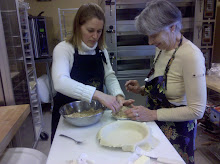
I decided I was going to carry on the family lard crust pie making tradition and sell them in the store. How hard could it be? Well, like everything else it’s all about simple, quality ingredients and good technique. The ingredient part is easy – we grow most of the fruit or get what we don’t have from other local farmers. We render the lard (aka cooking down the pig’s fat) in our large ovens at the store. I’m using flour milled in the Finger Lakes and organic spices, oatmeal and butter. Mom helped me with the crust mixing and edging techniques, and has passed down her favorite recipes. I’m using a dough roller at the store. That takes some practice. Sometimes I feel like Lucille Ball in the candy factory.

I have four pies now - apple, apple-elderberry, Concord grape, and cherry with almond crumb topping. Strawberry and strawberry-rhubarb are next on the list as soon as I can get our delicious local berries in June. I feel this small sense of accomplishment every time I cut my wheat design in the top crust. My grandmother would be proud.

Easy…no way… but so worth the effort.

Sunday, January 3, 2010

A Fresh Start

Happy New Year! I can’t say that I’m a festive New Year’s person. I enjoy more the idea of a fresh start on a new year, a new season, a new project or motivation to finish old ones. I just closed out 2009 with a great holiday with my family who all travel in from out of town. The snowy Sunday afternoon I’ve been dreaming about is here. Finally a chance to sit down with a mug of hot chocolate (a homemade Christmas gift from my niece Liz) and regroup looking forward and planning for the year ahead.

In agriculture, the new year is an opportunity to get caught up on bookwork, be thankful for the good things from the previous year and hope that the not so good things don’t repeat. I’ve realized what I love about agriculture is its seasonality… putting everything to bed for the winter after a busy summer and fall, and looking forward to getting everything back out in the spring. The cyclical nature of the farm is comforting to me and never boring. Fresh starts are part of the whole cycle.

Thursday, August 20, 2009

Pear in a Bottle?

How do we get those pears in that bottle? We had been doing some online research for a unique birthday gift for Dad and came upon Pear Brandy with a pear in the bottle grown and produced in Oregon. As I read about the process and looked at the pictures I thought that was something we could try with our own Bartlett pears.

We decided to experiment and used recycled wine bottles and baling twine figuring someday we would find a local producer who could use the bottles with one of their products. We tie baling twine around the bottle to suspend the bottle in the tree. During the first week of June, when the pear is pinky finger size, we insert the pear on the branch into the bottle and invert in the bottle, suspending it and tying it into the tree. Later in August, we harvest the bottles.

Last year we were talking with the owners of Chateau Buffalo and in passing they said they were looking for someone to grow pears in a bottle. They were working on a pear cider blended with pear brandy that had a high enough alcohol content to preserve the pear. This is our second season growing the pears in the bottle for Chateau Buffalo and we continue to improve our process. They clean the bottle before filling, which is also very labor intensive. Chateau Buffalo came up with beautiful packaging and sell the bottles in their store on Hertel Avenue. What a great gift! http://www.chateaubuffalo.com/

By the way, Dad enjoyed the brandy!

Tuesday, June 9, 2009

The Kids are Here!

May and June are two of my favorite months. Warmer weather, blossoms, green everywhere, new baby goats, and a visit from my nieces and nephew.

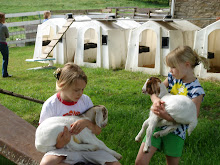
Our goat, Daisy, had twin kids a few weeks ago – two does. It’s amazing how agile they are in just a few days. They are already climbing up the planks and tower Dad built for the goats.

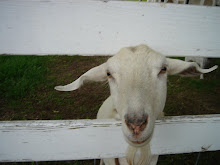
A few years ago, I talked Dad into getting a few goats to raise in our calf barn and corral. We stopped raising dairy heifer calves and I thought it would be a great space for the goats. They’ve become our backyard entertainment as well as part of the petting zoo during our U-pick apple season. They are crosses between Saanen (dairy goats) and Boer (meat goats). I thought about milking them and trying my hand at goat cheese, but now we keep breeding them for sale.

The best part is when my family visits and the kids get to play with the baby goats. Everyone was home this weekend for a family wedding, so my nieces and nephew were excited to see the new little does. Part of the tradition is letting the kids name the kids – maybe with a little guidance from me and final approval from Grandpa.

The final decision on names – May and June

Friday, April 10, 2009

Ms. Blackman Goes to Albany

In March, I traveled to Albany with a bus full of Farm Bureau members from all over Western New York. It was my third trip since becoming a board member of the Niagara County Farm Bureau. What the heck is Farm Bureau you ask? Well, I asked my father the same thing when I was a kid as he was rushing off to his monthly Farm Bureau meetings (one of many meetings Dad seemed to go to). Farm Bureau is actually a national agricultural lobbying organization but each state has its own bureau, and each county has its own board. It is defined as “a non-governmental, volunteer organization financed and controlled by families for the purpose of solving economic and public policy issues challenging the agriculture industry.” The policy development portion takes a “grassroots” approach. Many times Farm Bureau is simply summarized as “the voice of agriculture”.

I think that wanting to voice an opinion and make a difference in agriculture must run in the family. My father, grandfather, and great-grandfather were also Niagara County Farm Bureau board members. In fact, I found an old newspaper article from 1937 that quoted my great-grand father Walter Blackman Sr., “I do not know of a farmers’ organization from which greater and more far-reaching benefits are derived than those received through the Farm Bureau.”

Well - back to the Albany trip. This is our state’s opportunity to lobby and meet with all of the state Assemblymen/women and Senators to discuss important agricultural policy and budget issues concerning our own county and state. A group of us board a coach bus in Lockport, head to the thruway and pick up members along the way up to the Finger Lakes. We arrive at the Capitol building for informational meetings on important lobbying topics. Then we host an event for the legislators and staff featuring food and beverages all grown and produced in New York State. I’m always amazed by the variety and quality of products that this state creates. We sampled everything from wine and beer to ice cream and potato chips – oh yea, a bunch of healthy fruits, vegetables, cheeses and meats too!

The following day we have scheduled appointments with our legislators, including Senator George Maziarz and Assemblywoman Francine DelMonte. We try to educate them of our stance on specific political issues. This year’s topics included, of course, budget cuts affecting farming in NYS, labor issues, DOT regulations that affect trucking, and falling milk prices to name a few. After the Albany trip, some of the NYS Farm Bureau members head to Washington to lobby there. Maybe someday that will be next for me.

I learn a lot on these trips from the other farmers and the very knowledgeable New York State Farm Bureau staff. I guess in my family we’ve chosen to be a “voice in agriculture”. My belief is that it’s important in life to find a voice in something, especially now.

Links: New York Farm Bureau - http://www.nyfb.org/
Niagara County Farm Bureau - http://www.nyfb.org/niagara/

Monday, March 9, 2009

A Seedy Job

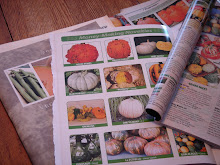
One of our late winter projects is ordering seeds. The catalogs get spread out on the kitchen table and Mom, Dad, and I flip through beautiful pictures of pumpkins, squash, and gourds. It’s hard to even think about fall or Halloween in early March, but orders need to be placed soon. We compare our lists from last year and decide to order more or less of a specific variety depending on its previous yield and sales. Dad usually finds the oddest-looking gourds like Warted Mix – small-multicolored gourds covered with warts. Mom and I like the heirloom pumpkins –Marina di Chiogga, the white Valenciano, and the French Rouge Vif Detampes or Cinderella pumpkin. Long Island Cheese, whose shape reminds us of a big wheel of Gouda, is the base pumpkin we use in our Pumpkin Maple Butter. The fun shapes and unique colors of the heirloom pumpkins allow for creative fall decorating. We love to stack them and make our “pumpkin topiaries”.

By the time we finished placing our orders from five different seed companies, with each of our “wish lists” satisfied, we ended up with about 40 varieties of pumpkins, 25 kinds of winter squash, and an assortment of 10 different gourds. A seedy job done. The next challenge – a good spring season conducive to getting all of these seeds planted! But after a long winter’s rest – none of us mind the outdoor job and chance to breathe in the fresh spring air.

Even if we end up ordering a few too many seeds, not much goes to waste at the farm. Last year our left-over misshapen pumpkins ended up at a wonderful place. In November, my friend Vicki (we go back to high school days), who works at the Buffalo Zoo, contacted us to see if we had extra pumpkins. We loaded up the zoo’s large dump truck and Vicki took them back to the animals. I guess the bears and elephants love them. She also explained that when the animals are given whole foods, they have to break them open making it more challenging and stimulating for them - and who doesn’t benefit from a good dose of Vitamin A?

Monday, February 9, 2009

Keeping Trim

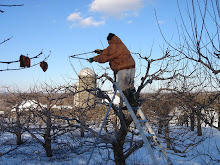
Many people ask “What goes on at the farm in the winter?” Well, it’s definitely not as busy as summer and fall, but the show does go on. Of course, the animals must be cared for, tax work must be completed, and Dad’s shop is full of repair projects, but one of the most important winter jobs is trimming the apple and pear trees.

Every December the guys bundle up, sharpen the trimming shears and haul the ladders to the orchards. “Opening up” the fruit trees is important for good air movement and sunlight. Some years suckers in the tops of the trees have three feet of new growth and need to be thinned out or headed back. Reducing the surface area of leaves and buds enhances fruit growth on the remaining buds. At the end of March or early April, the brush is windrowed from under the trees by hand and then forked with the tractor to the burn piles.

This year has been more difficult with the snowfall. It makes it harder to maneuver the ladders under the trees, so Dad blazed trails through the orchard with his old Moto-Ski snowmobile. I’ll have to admit that I’ve never trimmed the trees. I give the guys credit for being out in the orchards all winter long. To be honest, Mom and I prefer “keeping trim” snowshoeing and then enjoying a hot cup of tea.